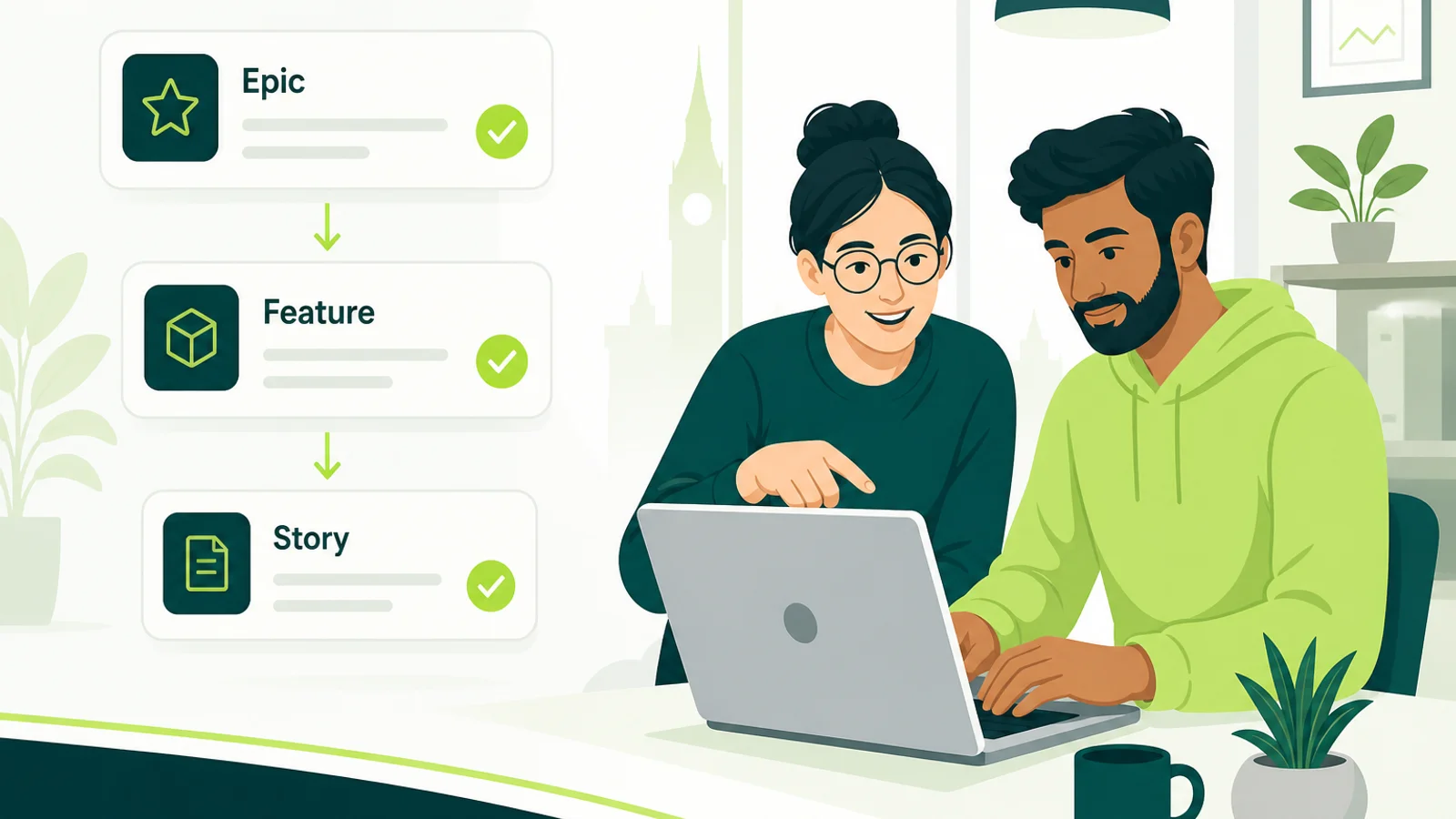
Epic definition: what is an epic?
An epic is a large body of work that is too big to ship as a single ticket. It groups related features or stories under one outcome, such as “enterprise SSO” or “shared inbox for support email.”
In plain terms: an epic is a theme you can explain to a customer, then break into shippable pieces. If you cannot describe the outcome in one sentence, the epic is probably too vague. Epics are planning containers, not an excuse to hide unfinished work forever.
Keep reading in this cluster: Product Requirements Document (PRD) for S…, Feature Request Workflow, Project Roadmap vs Product Roadmap for Sa…, and Feature request software.
Feature vs epic vs user story
Use these layers so planning stays honest:
- Epic: multi-week outcome (e.g. “Customers can invite teammates with roles”)
- Feature: a customer-visible capability inside the epic (e.g. “Invite by email”)
- User story: a delivery-sized chunk (e.g. “As an admin, I can resend an invite”)
Why the hierarchy matters for SaaS teams
Without layers, every request looks the same size. “Dark mode” and “rebuild billing” sit in one queue, and estimation becomes fiction. With layers, customers can vote on outcomes, product can sequence features, and engineering can pull stories into a sprint.
This also improves communication. Sales can say “SSO is on the roadmap” without promising a date for every internal story. Support can link customers to a public status instead of guessing from Slack.
SaaS examples
Concrete examples for a feedback product:
- Epic: public product roadmap with voting
- Features: columns, vote counts, status updates, shareable portal link
- Stories: add planned column, show vote total, notify voters on ship
- Epic: email to ticket shared inbox
- Features: connect mailbox, tags, assign owner, reply from ticket
- Stories: parse inbound email, create ticket, map tags from aliases
How epics connect to customer feedback
Many “feature requests” are really epic-sized. Customers ask for “SSO” or “better reporting.” Do not put the whole epic on a Kanban card. Capture the request, merge duplicates, then write a short brief or PRD for the epic and break it into features.
Votes tell you which epics matter. Stories tell you what to build this week. Keep both visible: feature request workflow for intake, public product roadmap for status.
A simple breakdown workshop
When a request looks large, run a short workshop:
- Write the epic outcome in one sentence
- List features a customer would notice if shipped alone
- For each feature, list stories that fit in a few days
- Pick the first feature that delivers partial value
- Park the rest; do not pretend everything ships together
Sizing tips so epics do not become forever projects
Healthy habits:
- An epic should fit in weeks or a quarter, not “someday”
- Ship a first feature that delivers partial value early
- Park unused stories instead of expanding scope silently
- Update the roadmap when the epic status changes
- Announce shipped features in the changelog so voters see progress
- Split an epic if you cannot name a first valuable release
Epic vs project
An epic is product language for a customer outcome. A project is delivery language for a time-boxed initiative. You may run a project to deliver an epic, but customers care about the outcome, not the Gantt chart.
For the planning distinction, see project roadmap vs product roadmap. Keep project milestones internal when they only describe engineering phases.
Where each layer lives in your tools
A practical mapping for early SaaS teams:
- Feedback board: raw requests and votes (often epic-sized themes)
- PRD or brief: epic intent and non-goals
- Public roadmap: epic or feature status customers can follow
- Kanban: stories and bugs in delivery
- Changelog: shipped features and fixes
Writing user stories that stay useful
Keep stories small and testable. “As an admin, I can invite a teammate by email and see pending invites” is better than “As a user, I want collaboration.” Add acceptance checks in plain language: what happens on success, failure, and duplicate invite.
If a story needs more than a few days, split it. If a story has no customer-visible result and no technical necessity, ask why it exists. Stories should serve a feature; features should serve an epic outcome.
Example walkthrough: from vote to shipped feature
A customer requests “better team access.” Ten others vote. You label it an epic: “Customers can invite teammates with basic roles.” The first feature is invite-by-email. Stories cover send invite, accept invite, and resend. You publish the epic on the public roadmap as planned, move invite-by-email to in progress, ship it, then announce in the changelog and mark that feature shipped while roles stay planned.
Voters see progress without waiting for the whole epic. That is the operating advantage of the hierarchy.
Common mistakes
Avoid these:
- Calling every ticket an epic so nothing is prioritised
- Publishing story IDs on the customer roadmap
- Building all features before shipping any value
- Letting epics grow every week without a non-goals list
- Skipping feedback links so nobody remembers why the epic exists
FAQ
What does epic mean in agile? A large work item that breaks into smaller stories or features.
What is the meaning of epic in product management? An outcome-sized theme that is too big for one ticket and needs sequenced delivery.
How many stories should an epic have? Enough to ship the outcome, few enough that you can finish. If you need dozens of stories before any value ships, split the epic.
Should customers see epics? They should see outcomes and status. You can label a roadmap card with the epic name if it is customer-friendly; keep internal story IDs private.
Is a feature the same as a user story? No. A feature is customer-visible capability. A user story is a delivery-sized slice that may only be part of that capability.
Next step
Take your top-voted request. Decide if it is a story, a feature, or an epic. If it is an epic, write the one-sentence outcome and the first shippable feature.
Manage intake and roadmap status in Votiq: feature request software or get started.