Overview
This page owns the commercial category: customer feedback software and customer feedback management software. If you are past spreadsheets and want one system for portal, boards, prioritization, shipping, and announcement, start here. Do not use this page for a PM-only scoring workflow, a weekly inbox ops playbook, or a founder retention thesis. Those have their own pages.
Ideas arrive from chat, email, sales calls, and in-product comments. Without customer feedback management, duplicates multiply, nobody owns triage, and customers never see outcomes. Votiq combines intake, voting, roadmap, lightweight Kanban, and changelog publishing so feedback is part of shipping.
Need a sharper lens after this hub? Product managers should open the product feedback platform page. Ops and UX teams should open user feedback management. SaaS founders focused on trial and churn should open SaaS customer feedback.
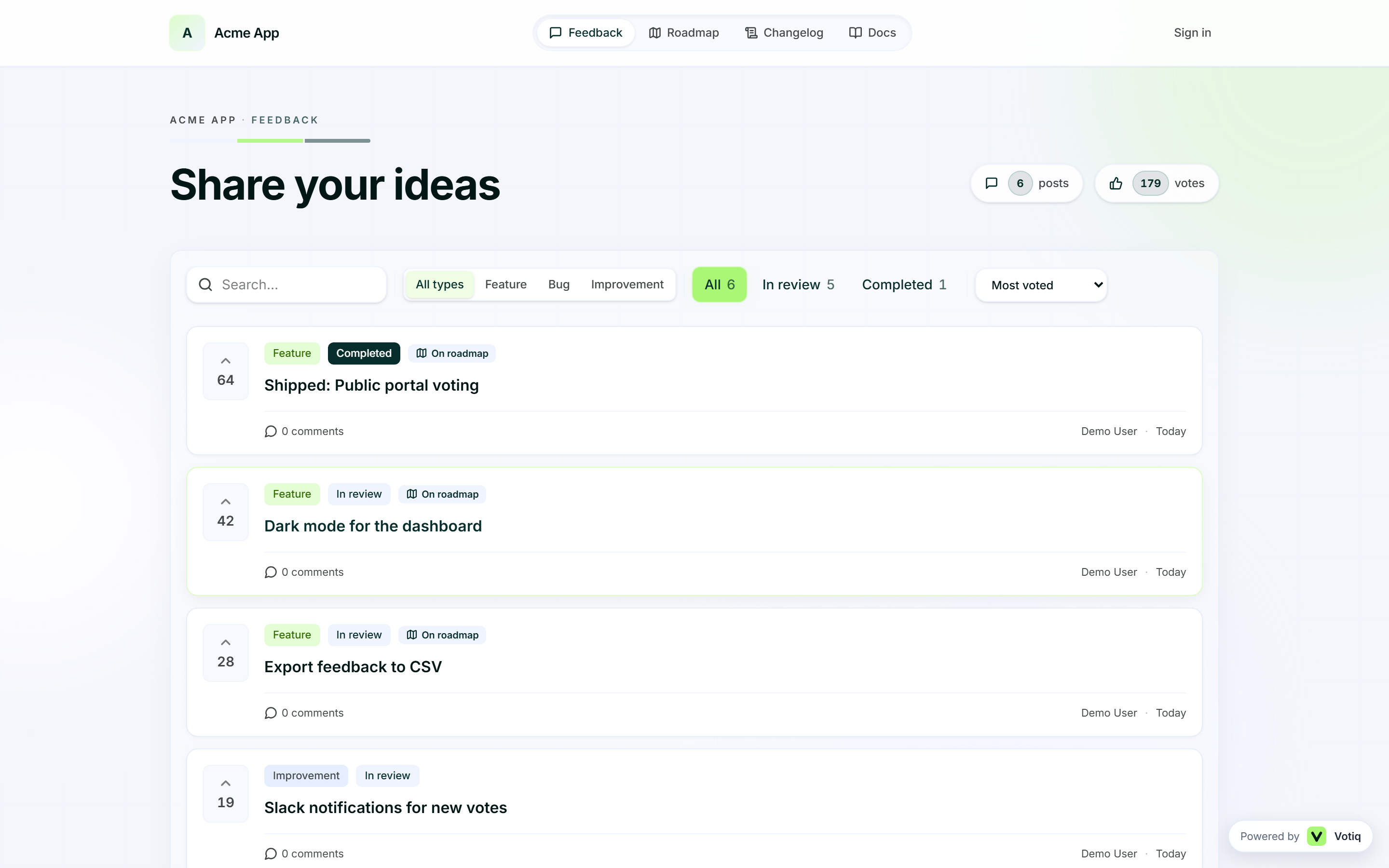
See customer feedback software in the product
Real Votiq screens, not mockups of a different tool.
What is customer feedback?
Customer feedback is the input people give you about using your product: feature ideas, bugs, confusion, praise, and friction they hit in real work. It can arrive as a widget submission, a portal vote, a support note, a sales call summary, or a short survey answer.
You do not need every channel on day one. You do need customer feedback management: one place to store the signal, attach an owner, and show what happened next. For another industry take on the topic, you can also read Alchemer’s customer feedback page.
Why customer feedback matters
Without a steady feedback habit, roadmaps fill with internal hunches and the loudest Slack thread. With customer feedback management, you see recurring blockers early, defend shipping choices with evidence, and reduce “any update?” noise when status is public.
Teams that triage weekly and announce outcomes usually keep contributors engaged. Teams that only collect messages train customers to stop speaking up.
What is customer feedback management software?
Customer feedback management software is the system that turns scattered comments into a managed backlog: capture requests, organize them on boards, prioritize with demand signals, and communicate outcomes when work ships. That management layer is what separates a living product loop from a suggestion box.
Votiq does that for SaaS product teams with an embeddable widget, public portal, voting, roadmap, lightweight Kanban, and changelog in one workspace. A contact form or spreadsheet can collect text; management software is what makes triage and follow-through repeatable.
If you want a wider market overview from another vendor, see Alchemer’s customer feedback software page.
Customer feedback tool vs customer feedback platform
A narrow tool often does one job well: send surveys, host reviews, or run a voting board. A broader platform connects intake to the rest of the product loop so the same request can move from idea to shipped work without copy-paste between apps.
Votiq is built as that connected customer feedback management loop for startups and growing SaaS teams, not as a full enterprise survey or VoC suite. When you compare vendors, ask whether you are buying one channel or a path from listen → decide → ship → announce.
What features should you look for in a customer feedback platform?
For SaaS product teams, start with intake that customers will actually use (widget or portal), a searchable board with owners and statuses, a way to merge duplicates, demand signals such as votes, a customer-facing roadmap or status view, and a changelog or release note path.
Add CRM or help-desk integrations when your process needs them. Heavy survey logic and enterprise governance matter more for large VoC programs than for a lean shipping team. Shortlist by running one real triage week, not by checklist size alone.
How do you gather and handle customer feedback?
Capture feedback in the product and on a public board first, then add surveys or review monitoring if you still have gaps. Tag bugs separately from ideas, assign an owner, and set a weekly triage so nothing sits unlabeled.
Handling feedback well means merging duplicates, prioritizing with votes plus impact, moving committed work to delivery, and telling requesters what changed. That is customer feedback management in practice. Silence after “thanks for the idea” is how suggestion boxes die.
How it works in Votiq
A healthy product loop is simple. Customers submit through a widget or your customer feedback portal. Items land on feedback boards where your team tags, merges duplicates, and assigns owners. Feedback prioritization combines votes with impact so loud requests do not automatically win. Winners move to a public roadmap, ship on a board your team already uses, and get announced so customers see the outcome.
That rhythm is what “close the feedback loop” means in practice: every meaningful request has a status path and a visible ending, shipped or politely declined.
How Votiq compares
Survey platforms excel at structured research and VoC programs. Help desks excel at conversations and SLAs. Heavy PM suites excel at internal planning. Votiq sits in the middle as customer feedback management software for product teams: portal and boards for intake, prioritization with votes, roadmap visibility, and changelog announcements without a six-month rollout.
Shortlist with a practical test. Install two candidates, submit real requests, run one triage, and check whether customers can see status without emailing you. The winner is the tool your team opens next week.
What is the best customer feedback management software for small businesses?
Small businesses pick customer feedback management software to learn what customers want, spot recurring issues, and decide what to improve next. The hard part is matching the tool to the job: surveys, CRM-tied CSAT, or an ongoing product feedback loop.
Survey tools for CSAT and questionnaires. SurveyMonkey’s customer service feedback use case is a common fit when you need customizable surveys, satisfaction scoring, analytics, and integrations. Before you buy, check independent buyer reviews on Capterra’s SurveyMonkey profile rather than relying on marketing claims alone.
Google Forms works when you need a free, simple form inside Google Workspace. Typeform is worth a look when completion rate matters and you want a more conversational survey experience.
CRM-tied feedback. HubSpot Customer Feedback suits teams already living in HubSpot. It pairs surveys and satisfaction tracking with service and CRM workflows, so feedback sits next to the customer record.
When surveys are not enough. SaaS and digital product teams often need more than one-off responses. They need continuous intake for feature requests, voting so demand is visible, prioritization, a public roadmap, and a way to announce what shipped. That is customer feedback management, not only a survey builder.
Where Votiq fits. Votiq is built for that product loop: collect feedback in a widget or portal, organize ideas on boards, prioritize with votes, plan on a roadmap, ship on Kanban, publish a changelog, and keep help in a Knowledge Base—without stacking four separate tools. The practical loop for small SaaS teams is collect → prioritize → build → publish → inform.
If you mainly need questionnaires and CSAT reports, start with SurveyMonkey, HubSpot, Typeform, or Google Forms. If you need affordable customer feedback management software that manages feature requests and closes the loop when you ship, Votiq is the stronger shortlist candidate.
Not the same as our companion pages
Search often lumps nearby pages together. Keep the roles separate so ranking signals stay clean.
Use this customer feedback management software hub for the category: portal, boards, prioritization, and closing the loop.
Use the product feedback platform page when a product manager needs revenue and segment prioritization for roadmap decisions.
Use user feedback management when UX, CS, or ops needs a weekly inbox and status lifecycle.
Use SaaS customer feedback when a founder needs trial, churn, and adoption signal, not a generic software overview.
Frequently asked questions
Quick answers about how this solution fits SaaS teams evaluating feedback and release tools.
What is customer feedback? +
It is what customers tell you about using your product: ideas, bugs, friction, and praise. It may arrive from a widget, portal, support thread, sales note, or survey. Customer feedback management means storing it in one backlog with an owner so it can turn into shipped work. Further reading: Alchemer.
Why is customer feedback important? +
It replaces guesswork with evidence. Recurring themes show what to fix or build next, public status cuts status emails, and announcing outcomes keeps people willing to submit again.
What are the benefits of customer feedback? +
Clearer roadmap priorities, fewer duplicate requests, faster support answers when themes are tagged, and higher trust when customers see their ideas ship or get a honest decline.
How do you get or gather customer feedback? +
Start where users already work: an in-app widget and a public portal. Add surveys or review monitoring only if those channels still leave gaps. Keep bugs and ideas labeled so triage stays fast.
How do you handle customer feedback? +
Assign an owner, merge duplicates, triage on a fixed cadence, prioritize with votes plus impact, move committed work to delivery, and close the loop with roadmap status or a changelog entry. That operating habit is customer feedback management.
What is customer feedback analysis? +
It is how you turn a pile of comments into decisions: group themes, weigh votes and account context, separate bugs from ideas, and track whether shipped changes reduced the same complaints.
What is customer feedback management software? +
Software that collects product input, organizes it on boards, helps you prioritize, and shows outcomes when you ship. Votiq does this with widget, portal, voting, roadmap, Kanban, and changelog. Further reading: Alchemer.
What features should I look for in a customer feedback platform? +
Intake customers will use, a searchable board with owners and statuses, duplicate merging, demand signals such as votes, customer-visible status or roadmap, and a way to announce releases. Integrations help later; a working weekly triage matters first.
What is the difference between a customer feedback tool and a customer feedback platform? +
A tool often covers one step (surveys, reviews, or a voting board). A platform connects listen → decide → ship → announce so the same request does not bounce between apps. Votiq is built for that customer feedback management loop for SaaS teams.
How does Votiq close the feedback loop? +
Promote items to the roadmap, ship on Kanban, mark related feedback shipped, and publish changelog entries customers can see on the portal and in the widget.